Share
Public holidays in Moldova 2027: 13 dates, only 9 fall on workdays
16.10.2026
6 min

Public holidays in 2027 bring Moldova 13 national days off, but only 9 of them fall on working days. The other 4 land on a Saturday or Sunday, and the Labour Code does not move them to another day. In 2026 we had 10 weekday holidays, so 2027 is a slightly stingier year.
The good news: the gap can be made up with planning, and the May holidays line up exactly with the pupils' Easter school break. Below you will find the full list, the rules for anyone who works on a holiday, and long-weekend plans.
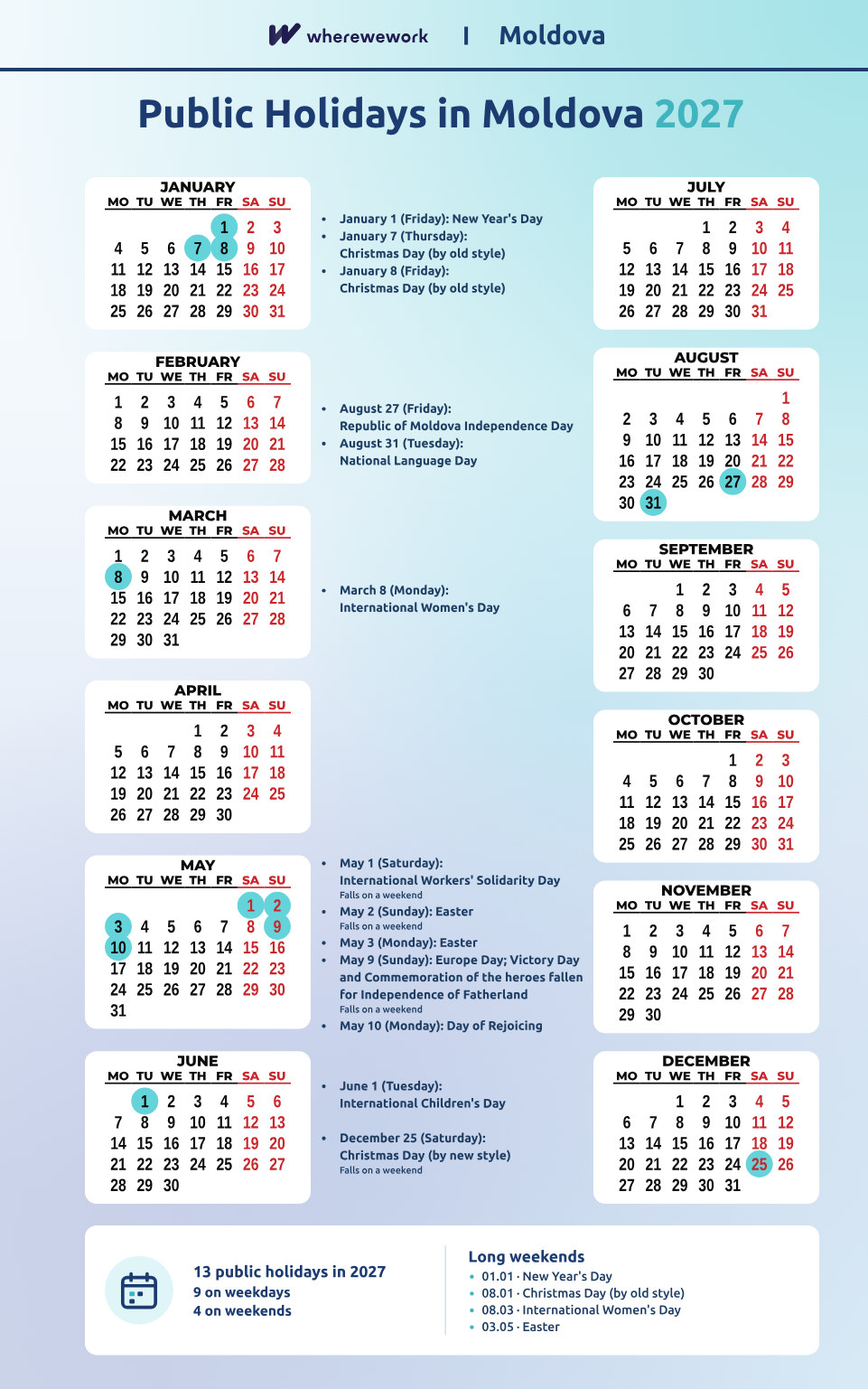
List of non-working public holidays in 2027
The list is set by Article 111(1) of the Labour Code of the Republic of Moldova (Codul muncii al Republicii Moldova), so the 2027 dates are already certain. Orthodox Easter falls late, on 2 May, pulling Easter Monday and Memorial Easter (Paștele Blajinilor, the day of remembrance of the dead) along with it.
-
1 January (Friday): New Year's Day
-
7 January (Thursday): Orthodox (Old Calendar) Christmas, first day
-
8 January (Friday): Orthodox (Old Calendar) Christmas, second day
-
8 March (Monday): International Women's Day
-
1 May (Saturday): International Workers' Solidarity Day, falls on a weekend
-
2 May (Sunday): Easter Sunday, falls on a weekend
-
3 May (Monday): Easter Monday
-
9 May (Sunday): Victory Day and Commemoration of the Heroes Who Fell for the Independence of the Homeland, as well as Europe Day, falls on a weekend
-
10 May (Monday): Memorial Easter (Paștele Blajinilor)
-
1 June (Tuesday): Children's Protection Day
-
27 August (Friday): Independence Day of the Republic of Moldova
-
31 August (Tuesday): Romanian Language Day
-
25 December (Saturday): Christmas (New Calendar), falls on a weekend
On top of these, each locality has its church patron saint's day (hram), declared a day off by the local council. That is why the National Trade Union Confederation of Moldova (CNSM) counts 14 holidays for an employee in a given locality: the 13 national ones plus the hram.
What happens to the 4 weekend holidays? You do not get a replacement day: Article 111 provides no compensation for holidays that fall on a Saturday or Sunday. According to a CNSM analysis, between 2027 and 2036 employees will lose at least 3 holidays every year to the weekend, and in some years as many as 5 or 6.
If you work on a public holiday: at least double pay
Under Article 111(2), work on public holidays is allowed only in units that cannot stop for technical reasons, in public-facing services, for urgent repairs, and for loading and unloading. Workers under 18 cannot be called in, while parents of a child under 4, people with severe or pronounced disabilities and other protected categories may work only with their written consent.
Pay is governed by Article 158. If you are paid by piece rate, by the hour or by the day, you receive at least double. If you have a fixed monthly salary, you receive at least one extra day's or hour's pay, and if you exceed your monthly working-time norm, at least double that amount. A day off instead of money is granted only at your written request and is unpaid, a point criticised in 2018 by the Council of Europe's European Committee of Social Rights.
Forcing employees to work on holidays without their written consent is fined under Article 55 of the Contravention Code: 30 to 60 conventional units for individuals, 70 to 120 for officials and 150 to 240 for legal entities. At 50 lei per unit, that means MDL 1,500–3,000, MDL 3,500–6,000 and MDL 7,500–12,000 respectively.
If you are scheduled on a public holiday, work out what the premium means for your net salary, starting from the gross salary in your contract. It is also worth checking how your pay compares with what others earn in the same role. And if you work in a sector that never stops for holidays (retail, hospitals, restaurants, transport), check national salaries for these jobs before you negotiate.
Public-sector staff, parents and the local patron saint's day
For public-sector employees, bridge days come only through a Government decision under Article 111(5); in companies, moving working days is decided by management after consulting employee representatives. Bridge days are not automatic: in 2025, public-sector staff had 1 May off, but Friday, 2 May, stayed a working day. No such decision exists yet for 2027.
For parents, 2027 brings a rare coincidence. According to the framework plan of the Ministry of Education and Research, the pupils' Easter break runs from 1 to 10 May 2027 and covers every May holiday: 1 May, Easter on 2 and 3 May, 9 May and Memorial Easter on 10 May. The winter break runs from 25 December 2026 to 10 January 2027, and the spring break from 1 to 8 March 2027.
The hram adds a day off wherever the local council declares it. For example, Strășeni District Court declared 27 October 2023, the town church's patron saint's day, a non-working day.
A note on annual leave: a draft from the Ministry of Labour and Social Protection would set minimum leave at 22 working days from 1 January 2027, instead of the current 28 calendar days. Minister Natalia Plugaru says people are entitled to “actual days of rest”, AmCham Moldova proposes a minimum of 20 working days, and the unions oppose the conversion. The draft is not law, so the plans below follow the rules currently in force.
Bridge days in 2027: plans with exact leave days
The rule that matters: under Article 113(1), annual leave of at least 28 calendar days is calculated excluding public holidays. A holiday in the middle of your leave does not use up a day, but a Saturday or Sunday does. So a leave request covering only working days costs you exactly as many days as the working days it includes.
-
1. New Year: 1 January is a Friday, so you get 3 days off, through Sunday, 3 January, without leave. Add 28, 29, 30 and 31 December 2026 (4 days of leave) and you are off for 10 days, from Friday, 25 December, to Sunday, 3 January.
-
2. Orthodox Christmas: 7 and 8 January fall on Thursday and Friday, so you get 4 days off through Sunday, 10 January, without leave. Add 4, 5 and 6 January (3 days of leave) and you get 10 days off, from Friday, 1 January, to Sunday, 10 January.
-
3. Women's Day: 8 March is a Monday, so you get 3 days off, from Saturday, 6 March, through Monday, without leave. Add 9, 10, 11 and 12 March (4 days of leave) and you get 9 days off, from Saturday, 6 March, to Sunday, 14 March.
-
4. The Easter marathon: from Saturday, 1 May, to Monday, 3 May, you get 3 days off without leave. Add 4, 5, 6 and 7 May (4 days of leave) and you get 10 days off, from Saturday, 1 May, to Monday, 10 May, exactly matching the children's Easter break.
-
5. Memorial Easter: from Saturday, 8 May, to Monday, 10 May, you get 3 days off without leave. Add 11, 12, 13 and 14 May (4 days of leave) and you get 9 days off, from Saturday, 8 May, to Sunday, 16 May.
-
6. Children's Protection Day: 1 June is a Tuesday. Take Monday, 31 May (1 day of leave), and you get 4 days off, from Saturday, 29 May, to Tuesday, 1 June. Take 31 May and 2, 3 and 4 June (4 days of leave) and you get 9 days off, from Saturday, 29 May, to Sunday, 6 June.
-
7. Independence Day: 27 August is a Friday, so you get 3 days off, through Sunday, 29 August, without leave. Add 23, 24, 25 and 26 August (4 days of leave) and you get 9 days off, from Saturday, 21 August, to Sunday, 29 August.
-
8. Romanian Language Day: 31 August is a Tuesday. Take Monday, 30 August (1 day of leave), and you get 5 days off, from Friday, 27 August, to Tuesday, 31 August. Take 30 August and 1, 2 and 3 September (4 days of leave) and you get 10 days off, from Friday, 27 August, to Sunday, 5 September.
File your request for early May well in advance, especially if you have school-age children. The quieter weeks around the holidays are also a good moment to update your CV and browse open jobs.
Conclusion: a stingier year, but easy to plan
In 2027, the advantage does not come from the number of holidays but from how you place your leave on the working days around them. And if you land a job interview, ask how the employer handles holiday work and extra days off. The answer says a lot about how you will spend your next holidays.
Share
What I read is worth it:
Read all the articles about
About the crafts Balance Career planning Economic Editorial Employee experience Employer branding Entrepreneurs Ethics Events HR Metrics International Off topic Legislative Workforce planning Negotiation Labour marketArticle written by:
 wherewework.md
Comments
0 comments
No comments! Be the first to comment on this article!

Access your account and add your comment
About the crafts


Subscribe to the Newsletter
Read articles of interest from wherewework.md contributors
