Share
Minimum Wage in the Republic of Moldova in 2026: Current Level, Evolution and Context
28.11.2025
3 min
The minimum wage in the Republic of Moldova is a key instrument for protecting low-income workers and an important indicator of the country’s living standards. In a context marked by inflation and economic pressure, the 2026 increase aims to provide a basic level of financial security, even though the minimum wage remains modest compared to EU standards.
1. What is the minimum wage in 2026 and to whom it applies
Starting 1 January 2026, the national minimum wage in the Republic of Moldova was increased to 6,300 MDL per month, up from 5,500 MDL in 2025. The increase amounts to 800 MDL, or approximately 15%, and applies to full-time employees working a complete monthly schedule.
The level of 6,300 MDL is equivalent to approximately €318–€320, depending on the exchange rate, and also sets a minimum hourly wage of 37.28 MDL. This is the minimum amount employers are legally required to pay a full-time employee, regardless of the sector of activity.
2. How the minimum wage evolved in recent years (2022–2025)
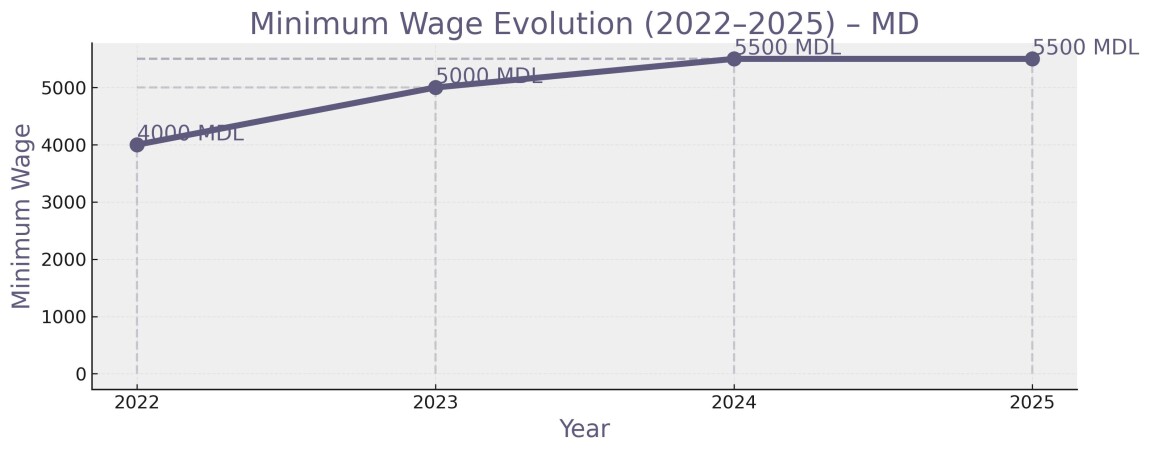
In recent years, the minimum wage has increased gradually to keep pace with inflation and cost-of-living pressures. In 2023, it stood at roughly 4,000 MDL. In 2024 it increased to 5,000 MDL, and in 2025 it reached 5,500 MDL, representing a growth of around 10 percent compared to the previous year. The upward trend reflects efforts to maintain a basic level of income protection for workers in a challenging economic environment.
3. What the 2026 minimum wage means in practice (MDL, euro equivalent, purchasing power)
The minimum wage of 6,300 MDL (approximately €318–€320) provides a slightly higher basic income compared to previous years, but remains insufficient for many households, especially in urban areas where costs are significantly higher. Expenses such as rent, utilities, transportation and food continue to absorb most of this income, meaning that the minimum wage mainly covers essential needs.
Although the 2026 increase helps partially offset inflation and brings a slight improvement compared to 2025, purchasing power remains low, and the impact of the increase is still limited in terms of ensuring a decent standard of living in the long term.
4. Legislative context and reasons for the increase
The Government set the level of 6,300 MDL following consultations with social partners, with the aim of protecting low-income workers and reducing the risk of in-work poverty. The decision is part of a gradual minimum wage increase strategy, designed to mitigate the effects of inflation and rising living costs.
The increase seeks to maintain a balance between the economy’s capacity to sustain wage growth and the population’s real need for social protection in an ongoing difficult economic context, without placing excessive pressure on employers, particularly in the private sector.
5. Limitations and challenges – what the minimum wage does not cover
Even with the 2026 adjustment, the minimum wage in the Republic of Moldova remains among the lowest in Europe. The level of 6,300 MDL (approximately €318–€320) is difficult to compare with minimum wage thresholds in EU member states, where base incomes are significantly higher.
High inflation and elevated prices for basic goods continue to erode the real value of this income, limiting the positive impact of the increase. Moldova’s economy, characterised by low productivity and a fragile private sector, further restricts the scope for faster minimum wage growth.
Although the minimum wage remains a necessary social protection tool, it is not sufficient to ensure a comfortable standard of living, nor does it significantly reduce economic gaps compared to neighbouring EU countries.
Increase of the forecasted average wage in 2026
In 2026, the forecasted average monthly wage in the Republic of Moldova is set at a higher level compared to the previous year, reflecting government expectations regarding economic growth and labour market developments. This increase plays an important role as a reference indicator, used in the calculation of social contributions, allowances, social benefits and certain penalties, without constituting a mandatory wage level for employers. The rise in the forecasted average wage occurs alongside the increase in the minimum wage and supports the broader objective of gradually adjusting incomes to living costs.
Conclusions
The minimum wage of 6,300 MDL in 2026 represents a necessary step toward supporting low-income employees and partially compensating for rising living costs. However, the level remains modest and insufficient to ensure a sustainable standard of living. To truly improve the situation, the country will need stronger economic growth, higher productivity and broader social policies. The minimum wage is important, but it is only one component of a more complex system that shapes overall living standards in the Republic of Moldova.
Share
What I read is worth it:
Article written by:
 wherewework.md
Comments
0 comments
No comments! Be the first to comment on this article!

Access your account and add your comment
Legislative


Subscribe to the Newsletter
Read articles of interest from wherewework.md contributors